
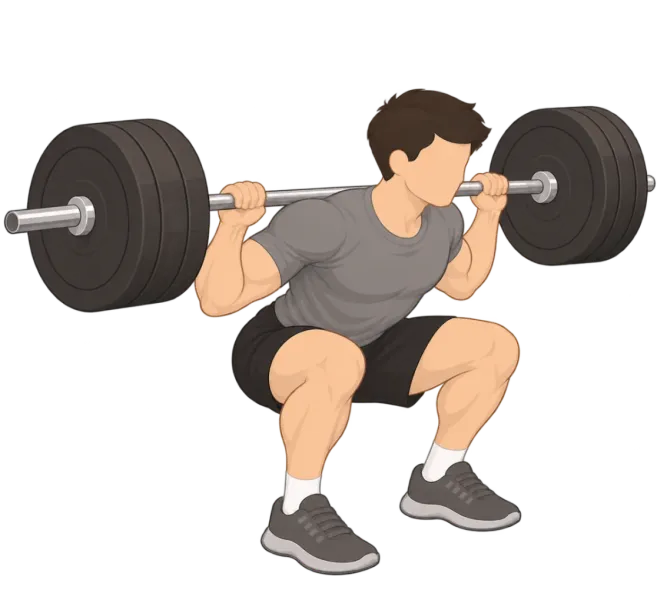
What a one-rep max is
Your one-rep max, or 1RM, is the most weight you can lift for one repetition with good form. It is the standard measure of maximal strength on a lift, and the starting point of every programme written in percentages: “4 sets of 5 at 80%” means 80% of your max.
You can test your max directly, or estimate it from a set with more reps. The calculator above does the second.
How to calculate your 1RM from a set
Take a set you have done: the weight and how many reps you completed. The Epley formula, the most widely used, says:
1RM = weight × (1 + reps ÷ 30)
For example, 185 lb for 6 reps gives 185 × (1 + 6 ÷ 30) = 185 × 1.2 = 222 lb.
Other formulas exist. Brzycki (weight × 36 ÷ (37 − reps)) lands almost exactly on Epley around 10 reps and a little lower below that. Neither is “the right one”: both are approximations built on groups of people, and the gap between them is nearly always smaller than your day-to-day variation.
The calculator uses Epley with two rules, the same ones the Tiero app uses:
- with one rep, your max is the weight itself;
- past 12 reps, it gives no number.
How accurate the estimate is
Accurate enough to train with, not enough for a meet. Three things move it:
Reps. The longer the set, the further the estimate drifts. A study that predicted 1RM from 5-, 10- and 20-rep sets and compared it with the real thing found the best predictions came from the shortest sets (Reynolds and colleagues, 2006). That is why the calculator stops at 12 reps, and why a set between 3 and 10 is the best input.
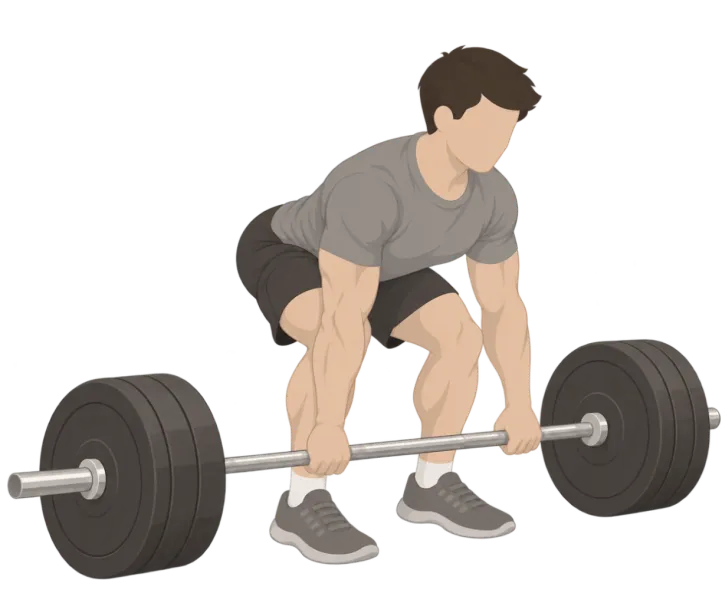
The lift. Formulas don’t work equally well everywhere. A classic study tested seven of them on the bench press, squat and deadlift: they tracked the real max closely, but on the deadlift every single one underestimated it, by roughly 9-14% (LeSuer and colleagues, 1997).
How close you went to failure. Formulas assume the set went to, or very near, failure. If you stopped with three reps left in the tank, your true max is higher than the estimate. That is why many lifters log reps in reserve (RIR) to say how close a set was (Helms and colleagues, 2016).
How to use the percentage chart
Under the result you’ll find what a set of 1 to 12 reps should weigh by the same formula. It helps in two ways:
- choosing a working weight: if your estimated max is 100 kg and you want sets of 8, the chart tells you where to start (about 79 kg);
- reading a percentage-based programme without doing the maths by hand.
Weights are rounded to the nearest half kilo or pound, because that’s how plates work. And it is an estimate: if your set of 8 turns into 10, your max is higher than you thought, which is good news.
Testing a true max, if you want to
You don’t need to: you can train perfectly well on an estimated max. If you want to test it anyway:
- warm up in steps: a few light sets, then heavier and heavier singles with longer rests between them;
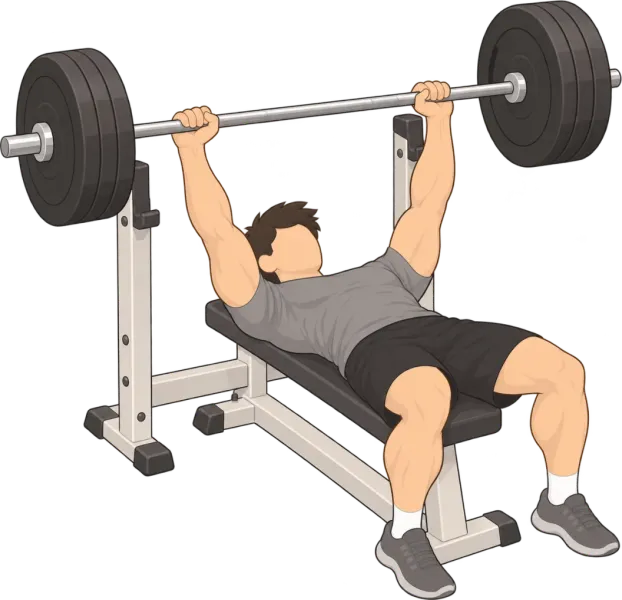
- use the safety pins in the rack or a spotter, especially on the bench press and squat;
- stop when your form breaks down: a max with a rounding back is a risk, not a max;
- do it fresh, not at the end of a session.
If you have an injury, pain or a medical condition, talk to a doctor first.
How to increase your max
Maximal strength mostly grows by training heavy on the lift you want to improve. A meta-analysis comparing heavy and light loads found similar muscle growth, but more strength with heavy loads (Schoenfeld and colleagues, 2017). In practice:
- Train the lift often, two or three times a week: strength is a skill too.
- Do a good share of your sets between 1 and 6 reps, with the long rests they need: 2-3 minutes or more on the main lifts (ACSM, 2009).
- Progress a little at a time: one more rep, or 5 lb more, when the set moves cleanly.
- Build muscle with the rest of your training: a bigger muscle has more strength potential. The guides on how many sets per week and how to build muscle explain how.
- Log everything: without last week’s numbers, progression is guesswork.
If you log your sets in Tiero, your estimated max updates after every set, and each exercise shows its line over time and your records at 1, 3, 5, 8 and 10 reps.
Frequently asked questions
Which formula does the calculator use?
The Epley formula: weight × (1 + reps ÷ 30). With a single rep, your max is the weight itself. It is the same rule the Tiero app uses for the estimated max of every exercise.
Why doesn't it calculate past 12 reps?
Because the more reps in a set, the further the estimate drifts from your true max: at 15 or 20 reps you are testing endurance more than maximal strength. For a useful estimate, pick a set between 3 and 10 reps.
Does it work with dumbbells?
Yes: tick “Dumbbells” and enter the weight of one dumbbell. The max you get is per dumbbell, not the two added together.
Is it accurate for every lift?
Closest on the bench press and squat. On the deadlift, formulas tend to underestimate your real max, so read the number as a floor.
How often should I recalculate it?
Whenever you do a heavy, clean set. If you log your workouts, the estimated max updates on its own and you can see it change over time.
Sources
- Epley B. Poundage chart. Boyd Epley Workout. Lincoln (NE): Body Enterprises; 1985.
- Brzycki M. Strength testing: predicting a one-rep max from reps-to-fatigue. Journal of Physical Education, Recreation & Dance. 1993;64(1):88-90. doi.org
- LeSuer DA, McCormick JH, Mayhew JL, Wasserstein RL, Arnold MD. The accuracy of prediction equations for estimating 1-RM performance in the bench press, squat, and deadlift. Journal of Strength and Conditioning Research. 1997;11(4):211-213. doi.org
- Reynolds JM, Gordon TJ, Robergs RA. Prediction of one repetition maximum strength from multiple repetition maximum testing and anthropometry. Journal of Strength and Conditioning Research. 2006;20(3):584-592. doi.org
- Helms ER, Cronin J, Storey A, Zourdos MC. Application of the repetitions in reserve-based rating of perceived exertion scale for resistance training. Strength and Conditioning Journal. 2016;38(4):42-49. doi.org
- Schoenfeld BJ, Grgic J, Ogborn D, Krieger JW. Strength and hypertrophy adaptations between low- vs. high-load resistance training: a systematic review and meta-analysis. Journal of Strength and Conditioning Research. 2017;31(12):3508-3523. doi.org
- American College of Sports Medicine. Progression models in resistance training for healthy adults. Medicine & Science in Sports & Exercise. 2009;41(3):687-708. doi.org