
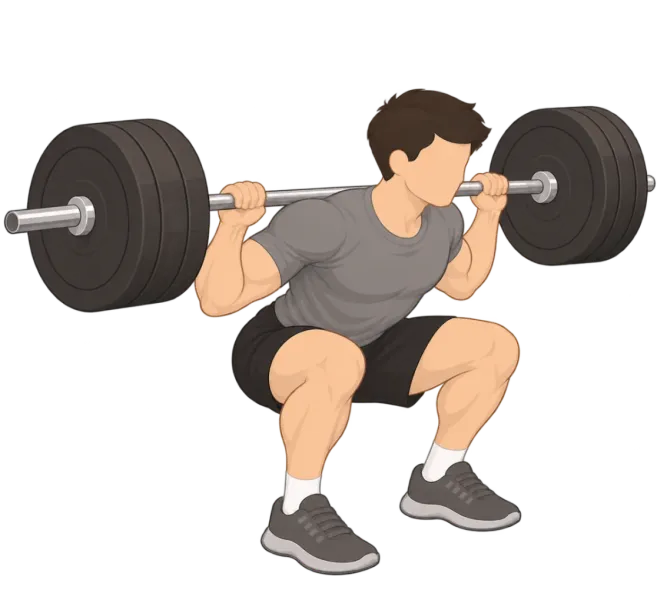
Which set to use
- A set of 3 to 8 reps, taken close to failure with your form intact.
- The same depth every time. A squat to parallel and one above parallel are different lifts: if your depth changes, your estimated max changes without you getting any stronger.
- The same squat. High bar or low bar, belt or no belt: anything works, as long as you compare like with like.
In long sets of squats your lungs give out before your legs, so for an estimate a short, heavy set after a full rest works best. In a study of trained lifters, those resting 3 minutes between sets gained more squat strength than those resting 1 minute (Schoenfeld and colleagues, 2016).
Safety
Do heavy sets inside the rack, with the safety arms just below the bottom of your squat: if a rep doesn’t come up, you set the bar down and step out. If you feel pain in your back or knees, stop and see a doctor or physiotherapist.
How to bring it up
Squat two or three times a week, with heavy sets and longer ones for your quads and glutes, and the patience to add a little at a time. The general rules are on the one-rep max calculator page.
The muscles that work
- Quads Primary
- Glutes Secondary
How the Tiero Body counts them: the primary muscle gets the whole set, each secondary half of it.
Sources
- Epley B. Poundage chart. Boyd Epley Workout. Lincoln (NE): Body Enterprises; 1985.
- LeSuer DA, McCormick JH, Mayhew JL, Wasserstein RL, Arnold MD. The accuracy of prediction equations for estimating 1-RM performance in the bench press, squat, and deadlift. Journal of Strength and Conditioning Research. 1997;11(4):211-213. doi.org
- Schoenfeld BJ, Pope ZK, Benik FM, et al. Longer interset rest periods enhance muscle strength and hypertrophy in resistance-trained men. Journal of Strength and Conditioning Research. 2016;30(7):1805-1812. doi.org