
Which set to use
The bench press is the lift where formulas work best: in studies comparing them with tested maxes, bench press estimates were the closest (LeSuer and colleagues, 1997). To keep yours close:
- use a set of 3 to 8 reps: the shorter the set, the better the estimate (Reynolds and colleagues, 2006);
- take it close to failure, with your form intact: stop with three reps in the tank and your real max is higher than the number you get;
- keep the lift the same: grip, arch and where the bar touches. A touch-and-go bench and a paused bench don’t give the same number.
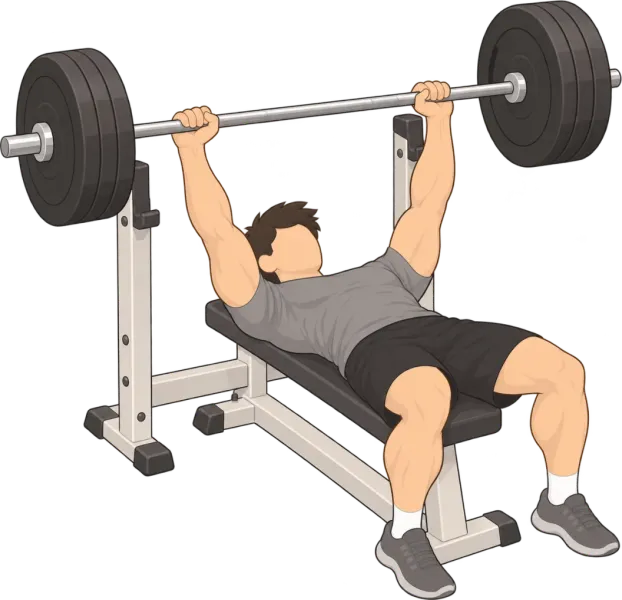
This calculator is for the barbell bench. For dumbbells, use the general calculator with “Dumbbells” ticked and enter the weight of one dumbbell.
Safety
The real risk on the bench is getting stuck under the bar. Set the rack’s safety pins at the right height or ask someone to spot you, and don’t use a thumbless grip. If you train alone, the pins are the most important part of the set.
How to bring it up
The bench grows by benching: two or three times a week, with heavy sets of 3 to 6 reps and longer ones to build chest, shoulders and triceps. The general rules are on the one-rep max calculator page; for volume, see how many sets per week.
The muscles that work
- Chest Primary
- Triceps Secondary
- Shoulders Secondary
How the Tiero Body counts them: the primary muscle gets the whole set, each secondary half of it.
Sources
- Epley B. Poundage chart. Boyd Epley Workout. Lincoln (NE): Body Enterprises; 1985.
- LeSuer DA, McCormick JH, Mayhew JL, Wasserstein RL, Arnold MD. The accuracy of prediction equations for estimating 1-RM performance in the bench press, squat, and deadlift. Journal of Strength and Conditioning Research. 1997;11(4):211-213. doi.org
- Reynolds JM, Gordon TJ, Robergs RA. Prediction of one repetition maximum strength from multiple repetition maximum testing and anthropometry. Journal of Strength and Conditioning Research. 2006;20(3):584-592. doi.org