
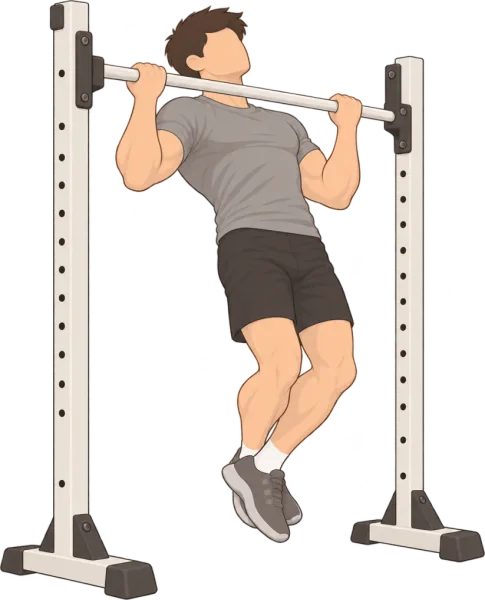
Why body weight counts
On a pull-up you don’t lift the belt: you lift yourself with the belt on. At 75 kg with 10 kg hanging, the bar holds 85 kg, and that’s the number the formula makes sense on. Applied to the added weight alone it would give a max of 11.7 kg, which means nothing.
Body weight counts in full: that’s the convention in weighted calisthenics and streetlifting. Strictly speaking you don’t lift every gram of your body, but what matters is always using the same sum, so two estimates months apart can be compared.
How to calculate it
- Add body weight and added weight: 75 + 10 = 85 kg.
- Apply the Epley formula to the total: 85 × (1 + 5 ÷ 30) = 99.2 kg.
- Subtract your body weight: 99.2 − 75 = about 24 kg added for one rep.
The calculator above does all three steps, and the chart shows the added weight for every rep count. It also works without added weight: enter 0, and the total is your body weight.
The usual rule for estimates applies: a set of 3 to 8 reps gives more precise numbers than a long one (Reynolds and colleagues, 2006). The formulas were tested mostly on the bench press, squat and deadlift (LeSuer and colleagues, 1997), so treat the pull-up estimate as a little looser.
Percentages, without the usual mistake
If a programme says “pull-ups at 80%”, take 80% of the total, not of the added weight:
- right: 80% of 99.2 kg is 79.3 kg; minus 75 kg of body, that’s 4.5 kg (about 10 lb) on the belt;
- wrong: 80% of a 24 kg max is 19 kg (about 42 lb), a load for one or two reps, not eight.
The calculator’s chart already uses the right sum. Where it shows a dash, body weight alone is, by the estimate, already too much for that many reps.
Weighted dips
Same sum: body weight plus added weight, formula on the total, then subtract your body. Use the same calculator.
Safely
Add weight only once your bodyweight pull-ups are clean: chin over the bar, arms straight at the bottom, no swinging. Use a dip belt with the plate secured, add a little at a time and come down from the bar under control.
In the app
In Tiero, pull-ups and dips are logged with the added weight, and your body weight lives in your profile: on bodyweight sets the load cell reads “kg added”. For how much back work to do, see how many sets per muscle per week.
The muscles that work
- Back Primary
- Biceps Secondary
How the Tiero Body counts them: the primary muscle gets the whole set, each secondary half of it.
Frequently asked questions
Should body weight count in a pull-up max?
Yes. Every pull-up lifts your body plus the added weight: apply the formula to the total, then subtract your body weight to know what to hang on the belt. Counting only the added weight gives wrong numbers, especially for percentages.
Does it work for pull-ups without added weight?
Yes: enter 0 as the added weight. With body weight alone the estimate works up to 12 reps; past that it isn't reliable and the calculator won't give one.
Does it work for dips?
Yes, the maths is the same: body weight plus added weight, formula on the total, then subtract your body weight.
Sources
- Epley B. Poundage chart. Boyd Epley Workout. Lincoln (NE): Body Enterprises; 1985.
- LeSuer DA, McCormick JH, Mayhew JL, Wasserstein RL, Arnold MD. The accuracy of prediction equations for estimating 1-RM performance in the bench press, squat, and deadlift. Journal of Strength and Conditioning Research. 1997;11(4):211-213. doi.org
- Reynolds JM, Gordon TJ, Robergs RA. Prediction of one repetition maximum strength from multiple repetition maximum testing and anthropometry. Journal of Strength and Conditioning Research. 2006;20(3):584-592. doi.org