
Which set to use
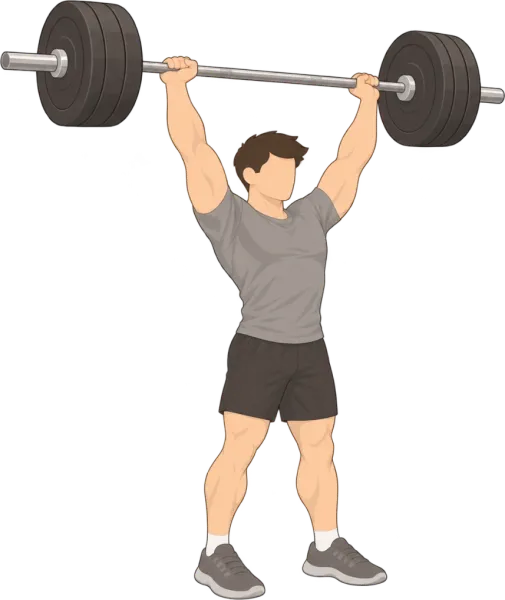
- Strict: in an overhead press your legs don’t drive. If you dip your knees to start the last reps, you’re doing a push press, which has a higher max: the estimate inflates.
- Standing or seated, always the same: they are two variations with different numbers.
- Between 3 and 8 reps: short sets give the best estimates (Reynolds and colleagues, 2006).
This calculator is for the barbell press. For dumbbells, use the general calculator with “Dumbbells” ticked and enter the weight of one dumbbell.
Safety
Squeeze your glutes and abs and keep your ribs down: arching your back to finish a rep shifts the load to your lower back. If your shoulder hurts with the bar overhead, stop and get it checked.
How to bring it up
The press moves slowly, in small steps: use 1.25 kg (2.5 lb) plates when you can, to add 2.5 kg (5 lb) in total. Shoulders and triceps also grow with the bench and other pressing work: count it in your weekly sets.
The muscles that work
- Shoulders Primary
- Triceps Secondary
How the Tiero Body counts them: the primary muscle gets the whole set, each secondary half of it.
Sources
- Epley B. Poundage chart. Boyd Epley Workout. Lincoln (NE): Body Enterprises; 1985.
- Reynolds JM, Gordon TJ, Robergs RA. Prediction of one repetition maximum strength from multiple repetition maximum testing and anthropometry. Journal of Strength and Conditioning Research. 2006;20(3):584-592. doi.org